

Café · New York · ⭐ 9.3/10 · 507 reviews · updated: 2026-08-10 20:44:22
Address: 750 11th Ave, New York, NY 10019, United States
If you have eaten well in New York in the last fifteen years, you have probably drunk this coffee without knowing whose it was. Afficionado Coffee Roasters spent well over a decade as a wholesale roaster supplying serious restaurant kitchens before it ever opened a room of its own, and when it finally did, it chose the far western edge of Hell’s Kitchen — opposite a park, a block from the river, and about as far from the tourist grid as Manhattan allows.
Highlights
- A restaurant roaster that went retail. The company was founded in 2008 and spent more than twelve years sourcing and roasting for top New York kitchens before opening this café in 2021. The standard was set by chefs long before it was set by walk-in customers.
- They use the whole coffee plant, not just the seed. A canned line built on five consumable parts of the plant — the bean, the dried cherry, the blossom, the parchment husk and the leaf — turns what farms normally discard into products, and into extra income for the growers.
- The roasting is done on a machine older than most roasters alive. A vintage 1955 Gothot at the company’s New Jersey roastery, run for a culinary rather than industrial result.
- The brewing includes a coffee sock. Alongside a serious espresso machine and batch brewers, the bar keeps the traditional cloth filter — a method from the coffee-growing world rather than from the equipment catalogue.
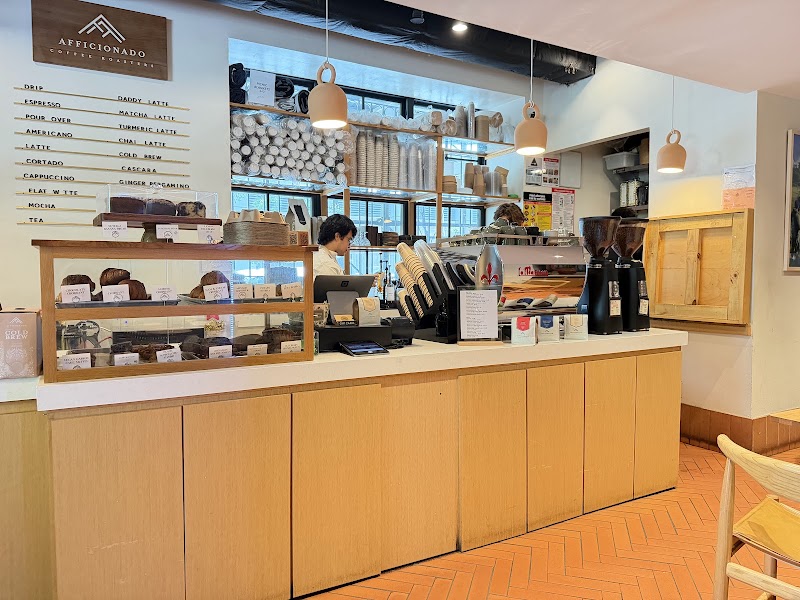
- The room was designed, not fitted out. An “elegant safari” concept by a local studio, tropical materials against modern lines, and art the founders collected on sourcing trips — the point is transport, not decoration.
- It is family, and it is local. Cousins started the company, one of the founders lives a few blocks away, and they took the space because they had been looking at it from across the street for years.
What’s in the cup
Start with the sourcing, because it is where this company differs. Afficionado buys single origins directly from farms across the coffee belt — Guatemala, Honduras, Nicaragua, Colombia, Peru, Bolivia, Ethiopia, Congo — and describes its roasting approach as culinary rather than industrial, which is exactly the vocabulary you would expect from a business whose first customers were chefs. Roasting happens at its own facility in New Jersey on a 1955 Gothot, a vintage drum machine of the kind roasters keep running because it produces a specific character rather than because it is convenient.
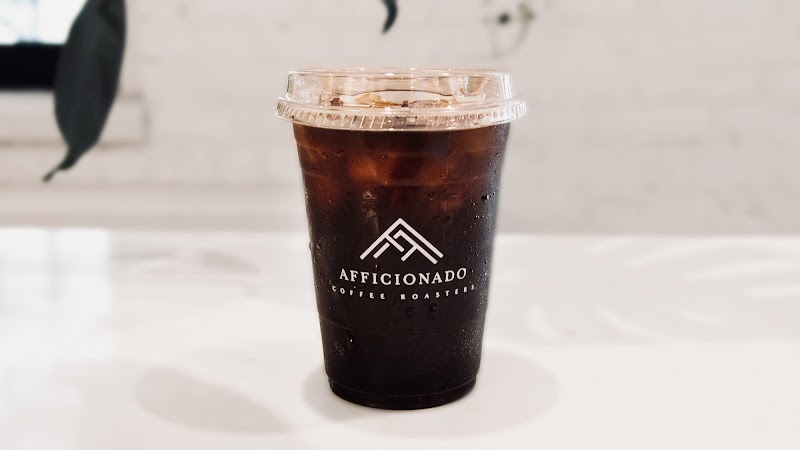
The genuinely original idea is the canned range, and it deserves explaining because nothing else on this list is doing it. A coffee farm produces far more organic material than the seed everybody drinks: the fruit around it, the flowers on the tree, the papery parchment layer, the leaves pruned after harvest. All of it is normally waste. Afficionado built five drinks out of those parts — a long-steeped single-origin cold brew, a cascara built on dried cherry with hibiscus and lime, a blossom drink using coffee flowers with elderflower and chamomile, a husk drink with ginger and unrefined cane sugar, and a leaf infusion. Buying those materials creates revenue for farms and workers out of things they used to throw away. It is the rare piece of coffee marketing that describes an actual mechanism.
At the bar itself, the setup is conventional in the best sense — a proper Italian espresso machine, batch brew for volume — with one deliberate exception: the coffee sock, the traditional cloth filter used across Latin America and the Caribbean. Keeping it on the menu in a Manhattan café is a small act of respect toward the places the coffee comes from, and it brews differently from paper: rounder, heavier in the body, closer to how the growing world actually drinks its own crop.
Who’s behind it
The business was founded in 2008 by cousins Adam Bossie and John Michael Beam, with Paul Merces as a co-founder — a New Jersey man who left the family business in 2007 to go into coffee. For most of the company’s life the customers were restaurants, not the public, which is an unusual apprenticeship: a wholesale roaster gets judged every service by professionals who will change supplier without sentiment if the espresso stops behaving.
The retail move was personal rather than strategic. Beam lives a few blocks from the café and the founders had been watching the space — previously an Italian restaurant — from across the street, waiting for it. Bossie has described the ambition in terms that most operators would not put in print: that this is more of an experience shop than a room designed to generate a lot of money. Whether that survives contact with Manhattan rent is a fair question, but it explains the choices — the design budget, the odd canned drinks, the vintage roaster.
The design itself was done by a local studio to an “elegant safari” brief: tropical materials, modern lines and art the founders brought back from trips to the farms they buy from. Even the soap in the restroom is from a proper perfumer. None of this makes the coffee better, but it tells you what kind of business you are in — one that treats the whole visit as the product.
What kind of visit it suits
The best case here is the unhurried one. This is a designed room in a part of Manhattan almost nobody walks through by accident, which means it is calmer than any comparably good café in Midtown. Come to sit with a filter coffee and actually look at the room, or to meet one person for a conversation that does not have to compete with a crowd.
It is also the strongest tasting visit on this list after the East Village comparison specialists, but for a different reason: the canned range gives you access to parts of the coffee plant you will not have drunk before. Ordering a cascara or a blossom drink alongside an espresso turns a coffee stop into something closer to an education, and it is the single most interesting thing to do here.
For working, the picture is promising but unconfirmed. The room is a proper sit-down space rather than a takeaway hatch, and the location means it is rarely under the seat pressure that a Midtown counter faces — but no laptop or Wi-Fi policy has been published, so ask rather than assume. The other honest scenario is the local one: this is the neighborhood café for the residential towers of the far west side and for anyone arriving at or leaving from the cruise terminal a couple of blocks away, and it is a far better start to a day than anything else within walking distance of the water.
The room and the atmosphere
The space runs to about twelve hundred square feet, which by Manhattan café standards is generous, and it was designed as a single idea rather than assembled from whatever fit. Tropical materials, warm tones, collected objects, and a bar that is meant to be looked at. The stated aim is to move you from a hard commercial avenue to somewhere in the coffee belt for the length of a cup, and the room gets closer to that than the description suggests.
The setting is the counterweight. Far west Hell’s Kitchen is car dealerships, service garages, residential towers and the wind coming off the Hudson; the park opposite gives the block its only softness. Arriving here feels like finding something that has no business being where it is, which is a large part of the pleasure. The crowd is local and light rather than churning — this is not a room you queue in.
What goes with the coffee
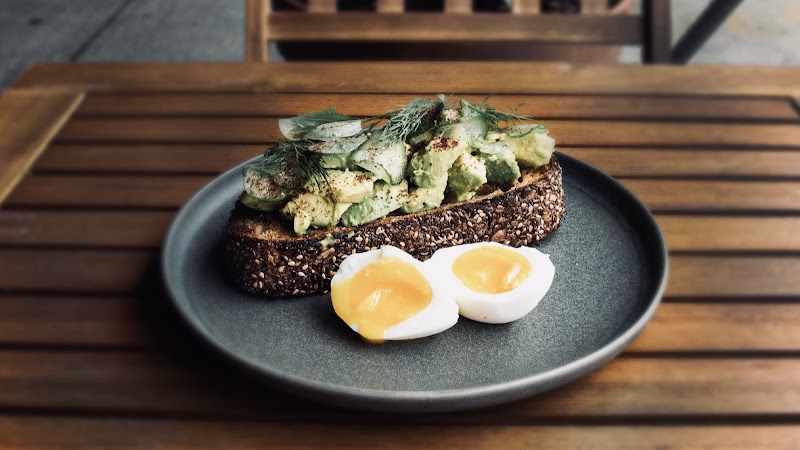
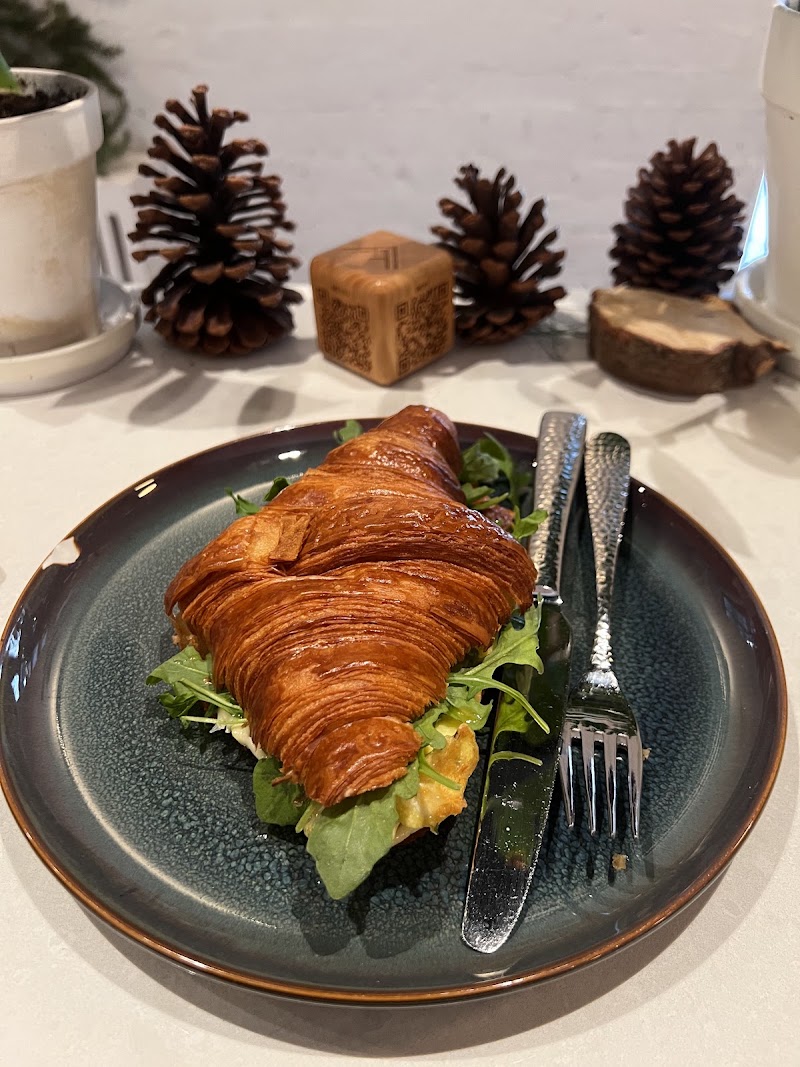
Food is not the main event, and the company has never claimed otherwise — this is a roaster’s café rather than a bakery with a coffee machine. Expect the usual counter accompaniments to a drink rather than a kitchen you would plan a meal around.
What fills that space instead is the drinks range, which is broader than almost anywhere: the canned plant-part line, the cold brew, the espresso and filter programs, and a stated intention to move eventually into beer, wine and cocktails built on coffee-plant ingredients. Treat the menu as the thing to explore here, rather than the pastry case.
When to come
Mornings belong to the neighborhood — the residential towers on this side of the island empty eastward at the start of the day, and the café catches that flow. The middle of the day is the quietest and the best time to sit properly, which is unusual in Manhattan and is a direct consequence of being off the main pedestrian routes.
Weekends are steadier than weekdays here rather than busier, since there is no office population to disappear. If a ship is in at the terminal nearby, the block gets a brief and very obvious wave of luggage. For a first visit, aim for a weekday afternoon: the room is at its calmest and the bar has time to walk you through the stranger half of the menu.
Getting there
This is the far western edge of Hell’s Kitchen, directly opposite DeWitt Clinton Park and about a block from the Hudson River waterfront. The Intrepid museum ship is a short walk south along the water, and the cruise terminal is a couple of blocks north.
Be realistic about transit: this is one of the least subway-served pockets of Manhattan. The nearest stations are three long avenue blocks east — the 50th Street station on the west side local lines is the usual choice — and the walk from them is genuinely a walk, into the wind on a bad day. Crosstown buses run much closer, and the waterfront path makes the approach pleasant if you are coming on foot or by bike from anywhere along the river.
Good to know
Two things to set expectations. First, the location is the price of admission: nobody stumbles across this café, and if you are not already on the far west side you are making a deliberate trip. It rewards the trip, but plan the walk.
Second, order beyond the espresso. The reason to come here rather than to any other good roaster’s café is the range built out of the coffee plant’s other parts, and skipping it means missing the entire argument the business is making. If you drink only a flat white, you will have had a very good flat white in a beautiful room — and you will have learned nothing about why this place exists.
Questions and answers
Do they roast their own coffee?
Yes, at the company’s own roastery in New Jersey, on a vintage 1955 Gothot drum machine. The company has been roasting since 2008, long before it opened a café.
What is the canned range about?
It uses five different consumable parts of the coffee plant — the bean, the dried fruit, the blossom, the parchment husk and the leaf — most of which farms normally discard. Buying them turns waste into income for producers, and the drinks taste nothing like coffee as you know it.
What is a coffee sock?
A traditional cloth filter used across Latin America and the Caribbean. The bar brews with it alongside modern equipment, and it gives a rounder, heavier cup than paper does.
Was this always a café?
No. Afficionado spent more than a decade as a wholesale roaster supplying leading New York restaurants, and this Hell’s Kitchen room, opened in 2021, was its first retail space.
Is it hard to get to?
Harder than anything else on this list. The far west side is a subway gap, so expect a walk of three long avenue blocks from the nearest station, or take a crosstown bus that runs much closer.
Can I sit and work?
The room is a comfortable sit-down space and it is rarely as crowded as a Midtown café, but no laptop or Wi-Fi policy has been published — so ask at the counter before committing to a long session.
Is there food?
Only the usual accompaniments to a drink. This is a roaster’s café; the investment went into sourcing, roasting and the drinks range rather than into a kitchen.
What should I order on a first visit?
An espresso or a filter to judge the roasting, and then one of the plant-part drinks — a cascara or a blossom — to understand what the company is actually doing. Ordering only the familiar things wastes the trip.
Opening hours
| Day | Hours |
|---|---|
| Monday | 07:00–17:00 |
| Tuesday | 07:00–17:00 |
| Wednesday | 07:00–17:00 |
| Thursday | 07:00–17:00 |
| Friday | 07:00–17:00 |
| Saturday | 07:00–17:00 |
| Sunday | 07:30–16:00 |
Photos
Visitor reviews
Reviews last updated: 2026-08-10 20:44:22
Data is refreshed monthly. Sources: newyorka.info and editorial picks based on reviews.
Справді наша улюблена кав'ярня в Нью-Йорку! Нам подобаються лате та їхній широкий вибір випічки та їжі Елі, бариста, завжди такий корисний та привітний щоразу, коли ми заходимо, і пам'ятає про наші замовлення. Нам под…
Одне з моїх нових найкращих кафе. Я так часто бігав повз це місце і ніколи не заходив, і, слава Богу, я нарешті туди дістався. Я замовив чорну каву / каву одного походження з Гондурасу. Неймовірно. Горіховий та квітковий…
Елегантний та затишний простір зі смачними лате та закусками. Я замовила грибний лате з еспресо без кофеїну, і він був дуже смачний! Я також попрацювала на своєму ноутбуці. Персонал дуже гостинний та привітний! Я скоро п…
Абсолютно смачно! Я скуштував кардамоновий лате, і це було моє найулюбленіше кафе в місті. Я також скуштував грецький йогурт. З точки зору смаку, це місце обов'язково варто спробувати.
Але… обслуговування було поганим.…
Відвідування Afficionado Coffee Rosters було феноменальним досвідом! Я сидів усередині та насолоджувався ідеально приготованим кавовим напоєм від Дженіс, однієї з барист. Вона дуже добре зналася на їхній каві та надала ч…